Editors note: This essay was originally posted on September 3, 2026, with the following foreword. Bolt is now a Knight of the Flame in the Rising Winds. The content of the text is presented here unaltered, except for minor formatting changes and contact information.
Hello Friends,I am here to share a document about my feast planning process. This document is the result of my final self assigned post-masterhood squire task. It has been a great pleasure to cook for y’all over the last 11 years. My focus is now shifting away from feasting as I pursue other passions in the game but I’m always happy to talk shop so please reach out!In service,Bolt
How I Cook a Feast.
By Bolt
Who am I?
I am Squire Bolt. I have been cooking meals for Amtgard groups in the Ohio/Indiana/Kentucky area since 2015. I have experience cooking meals for 100 to 300 people with a variety of budgets at both primitive sites and sites with kitchens. I received my Master Rose in 2024 primarily for my service cooking meals for the Rising Winds.
What is this Document?
This document outlines how I plan and execute a singular feast or event long meal plan for grand duchy (state-wide) or kingdom (multi-state regional) level events that feed 100 to 300 people. Some of the suggestions in this guide may be excessive for local level events (10 to 50 people) or insufficient for larger national events (500+ person) but I hope any person cooking meals for a group can find value in this guide.
My process and this document have 4 phases:
Assessment – Collecting information and asking all the questions.
Preparation – Budgeting, testing, building a team, writing a plan
Execution – Final food prep and the day of.
Evaluation – Learning from the experience to inform your future service.
Phase 1: Assessment
The assessment phase is about collecting as much information as possible so you can proceed forward and make an informed plan. These are the questions I ask when I first start planning a meal. To answer some of these questions you may need to reach out to your event team and other members of your community about their previous experience.
How many people are you serving?
Talk to the people in charge of the event you are cooking at to find the estimated attendance for the event and consult previous year’s attendance numbers if available. For multi-day events consider how the number of attendees will change throughout the event. Unsurprisingly most events tend to build in attendance with the least amount of people the first day and the most people on the final day of the event (usually Saturday)
What are the amenities where you are cooking?
Do you have access to a kitchen? Potable water? Electric power access?
Do you have a space to cook in or do you need to source your own tables and shade?
Does your organization or members of the organization own kitchen equipment (ie grills, smokers, extra large pots and propane burners) you can utilize? Understanding the tools you have access to will help inform your menu selections.
What is your Budget?
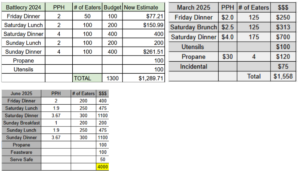
If your event team isn’t providing you with a specific budget, you will need to write one yourself. I prefer to budget with a price per head per meal system. This budget will be flexible and you can move the money between the meals as you start selecting your specific meals and gathering more accurate price estimates. Not all meals have the same per head cost. Breakfast is generally the cheapest meal at $1 to $2 per person. Lunch is usually between $2 to $4 per person and Dinner is usually $3 to $5 but can go higher for more extravagant meals. These numbers are based on my local 2025/2026 food prices and may increase in the future.
Example budgets:
What are the expectations of accommodations for assorted diets and allergies?
Which accommodations for different diets you chose to make are largely based on the culture of your group. In my region we generally provide a vegetarian or vegan option for all meals. If I can easily make dishes gluten free I will. It is important to have accurate ingredient lists and to clearly note common allergens. One way to easily accommodate vegetarians is to keep all of your side dishes vegetarian or vegan and then substitute your main protein with plant based options. I use a variety of plant based options including chickpeas, tofu, beans, extra veggies, and store bought meat alternatives.
What are you comfortable cooking?
Especially when starting out it can be much easier to cook scaled up versions of dishes you are already familiar with. What dishes do you enjoy cooking from scratch? Do you make lots of stews and soups? Do you enjoy pasta dishes? Are you a baker? Consider how this experience can shape what meals you decide to cook.
What are the expectations and preferences of the feast eaters?
The expected weather/temperature at your events is one of the largest factors in menu selection. In the summer foods like cold cut sandwiches, fruits, and other light snacks are more popular. Keep things light for breakfast and lunch but still provide a filling and nutritious meal for dinner to refuel everyone after their long day of activities. Cold weather events are a great time for your rich stews and soups, but keep in mind those primarily liquid meals aren’t great options for everyone so have some variety if you are planning multiple meals.
Phase 2: Preparation
The preparation stage is about creating a plan, testing your ideas, building a team, and being ready to hit the ground running in the final week(s) before your event.
Writing a menu & finalizing the budget
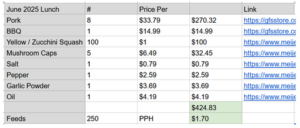
Now that you have collected your information you should start solidifying your budget and menu. At this point you should know approximately how many people you are serving and the total amount of budget available. Start pricing out your ingredients and create an itemized budget. Note on your budget where that price is from and do not consider sale prices at this stage of planning. It’s ok if this menu isn’t completely set in stone. Quantities of ingredients may shift after your test run and it’s easy to swap out sides if you change your mind later.
Test run
Do not cook dishes for the first time at an event. Test your recipe, your portion sizes, your flavors, and find a process that works for you. While it would be overkill to do full size test batches for your meal, I wouldn’t recommend making a tiny batch either. It’s important to understand how your recipe works at a medium scale (at least 10 servings) because there can be too much variance with ingredients while making a small batch. I have found that recipes written for serving at dinner parties scale better than recipes that serve a family.
Sourcing
There are 5 types of stores that I use to check prices for meals. These stores all have categories of items they specialize in so it’s worth shopping around.
Restaurant Supply stores:
Gordons Food Service or Similar
If you need a large quantity of an item, and your local restaurant supply carries it, they are probably the best price. GFS is my go-to for meat, basic produce, large canned goods, and large quantities of spices. I don’t recommend buying disposable utensils, plates, or bowls here.
Chain grocery stores:
Walmart, Aldi, Meijer, Kroger, and other regional chains.
Where I buy most food items that I don’t need in bulk. Small quantities of spices, produce not available at GFS, and all the random small non-food items needed for a meal, especially the last minute items you will forget.
Membership stores:
Costco or Sam’s Club
Great for pre-made sides, but I usually avoid pre-made sides to save money. Often the best price for large amounts of disposable silverware and plates. I’ve seen other people utilize these locations with success, but I often don’t feel a need for them.
Local businesses:
Butchers or local produce sellers.
You will sometimes pay a price premium when utilizing a local butcher, but they will often give you better trimmed and higher quality meat. In my experience butchers are a great option for beef but have less competitive prices for chicken and pork. These local businesses can be great assets, but will require calling around or talking to business owners about bulk pricing.
Online:
Amazon and online restaurant supply stores.
I don’t recommend buying perishable items online. A small shipping delay can throw a wrench into your plans. Amazon is a good option for chafing dishes, aluminum half pans, and other non-food necessities. Occasionally has the best prices on dried goods.
Create a plan
How are you cooking every part of your dish? What order are you cooking things in? How are you keeping items hot? How are you serving everything? How many hands do you need? Will you need to do significant prep work (Chopping or processing produce and meat)? Will you need extra hands for that prep work? How long will everything take? What time do you need to start cooking?
Pre-cooked items.
It can be a great option to pre-cook some portions of your meal. It is common to precook and freeze shredded chicken to ensure you are providing fully cooked safe chicken. I have also previously pre-made and frozen large quantities of roux, and baked goods. Pre-cooked items aren’t usually quite as good as fresh but can be worth it if they simplify your onsite logistics.
Write a detailed schedule.
This plan will be more complex the more complex your meal is. E.g.
1pm veggie and meat processing
3pm start gumbo
4pm start vegetarian option
6pm start water boiling for rice
7pm service
Finding volunteers
Volunteers for feast help can be very difficult to find before an event but often many people are willing to jump in to help on the day of. I recommend giving volunteers precise times to come help out with the specific activity they were interested in e.g. come back at 3pm to help with food prep, or 4 for cooking, or 6 to help serve the meal. Having a dedicated competent experienced feast assistant is the single most helpful resource you can have in the kitchen. Make friends with the feast folks around you, be this assistant for them when they need it, and appreciate them when they can help you. Reach out to households and fighting companies. Many people are willing to pitch in an hour of work with a group of their friends.
Phase 3: Execution
You’ve made a plan and you know what to do. The Execution phase is a ton of work, but it’s made easier through every step of preparation you’ve done already.
Create individual shopping lists for all stores.
Purchase your produce and meat as close to the event as possible. When feasible, schedule pickup for your large orders to save time and reserve your items. GFS store pickup is a life saver. Make sure to keep all of your receipts for reimbursement and/or financial record keeping.
Prepare all items you planned to cook before the event.
Be careful when putting large amounts of hot items into your fridge or freezer to ensure that it doesn’t raise the temperature to unsafe levels. It is recommended to use an ice bath to initially cool hot food before storing in the fridge/freezer. Freezing food flat in bags can make storage, transportation, and thawing easier.
Safe handling of food.
I’m not going to cover all of the things that go into keeping food safe. Please take a servesafe class and learn about best temperature, sanitation, and storage practices. If you’re on a primitive site I highly recommend using separate coolers for raw meats, raw veggies, and ready to eat items. For best cooler performance use a ratio of 2 parts ice to 1 part food. Keep your coolers in the shade or indoors when possible.
Keeping food hot
Once your cooler is empty and done keeping food cold it can be a great hot hold option. Portion your cooked food into half pans, cover in foil, label, and stack in your cooler. Alternatively, keep your food in the vessel it was cooked in. A giant pot of rice or mashed potatoes will stay hot for more than long enough to serve.
Have some fun.
You’re going to spend hours and hours in the kitchen, bring a speaker and listen to music, chit chat with your friends, take breaks. Bring a sweet treat or tasty beverage to enjoy when you need a break. Eat food and drink water. Cooking isn’t supposed to be miserable.
Phase 4: Evaluation
Wrapping up your experience and moving forward.
Take some time to reflect on how your plan went.
Where did you succeed and fail? How would you do things differently next time? What surprised you? What equipment would have made your life easier?
Calculate your total expenses and compare them to your original budget estimations.
Submit your receipts for reimbursement from the event.
Gather information about how people felt about your meal(s). It can be helpful to have others assist you in gathering this information to get insight from many groups.
Remember to thank your volunteers, and submit award recommendations if applicable.
Deciding how to move forward isn’t a choice you should make immediately. Did you have fun making the meal? Did you over commit yourself to more than you could handle or do you want to step up into additional responsibilities next time? I would always recommend waiting until you get home and decompress from an event before committing yourself to future service.
Bonus Notes:
random advice based in mistakes I’ve made that couldn’t fit elsewhere
Consider instant rice. I love real rice, it’s better than instant rice, but unless you have an industrial rice cooker, it sucks to cook in the quantities we need for a feast.
Dry brine your meat. Don’t go overkill on the salt, but a simple 24 hour dry brine will improve the flavor of your meal. I prefer food safe 5 gallon buckets for this but disposable plastic bags are another option.
Don’t rely heavily on small consumer appliances. You will destroy that air fryer.
For meals that need a roux , I highly recommend making a dry roux by baking the flour in the oven. This will make your day-of execution less tedious.
Buy a bunch of aluminum half pans and enough aluminum foil to cover them. These are incredibly versatile and greatly reduce the amount of dishes you need to do.
Get your food ready a little early and feed your servers before they serve everyone else.
Talk through your plans with someone who has feast experience. A new perspective helps you spot the issues you missed before they become a problem.
If your meat is frozen in large portions, it may take multiple days to thaw in the fridge. Give it enough time to safely thaw so you aren’t trying to cook a pork butt that is still frozen in the middle.
Double check that you have all the items you need hours before you actually start cooking. Keep your items grouped by meal.
If you made it all the way here I hope you found value in this guide. Please feel free to reach out to me on the Kingdom of the Rising Winds Facebook group or Discord server with any questions, I’m always happy to talk about feastin’.
Recent Comments